
A genomic language model is a type of artificial intelligence trained to read DNA the way other AI systems read sentences. Instead of words, it learns from long strings of the four DNA letters (A, C, G and T), picking up patterns that help predict what a stretch of genetic code does. It doesn’t diagnose a child, and it doesn’t read a person’s future. It’s a research tool that helps scientists make sense of enormous amounts of genetic data.
Why should parents, educators, and health professionals care? Many neurodevelopmental conditions, including some that affect early speech and language, have a genetic component. Better tools for interpreting DNA could, over time, help researchers understand why development unfolds differently for different children, and why one child responds to a therapy while another needs a different approach. That fits what we’ve always emphasized here: every child is unique, and the best care is customized and built by a multidisciplinary team.
But this is emerging science, and the honest picture includes limits. Predictions can be wrong, genetic data can be biased toward some populations, and a result on a screen is never a substitute for a full evaluation. This article explains what these models are, how they work, where they’re used, and what they can’t yet do.
What a Genomic Language Model Means in Plain Terms
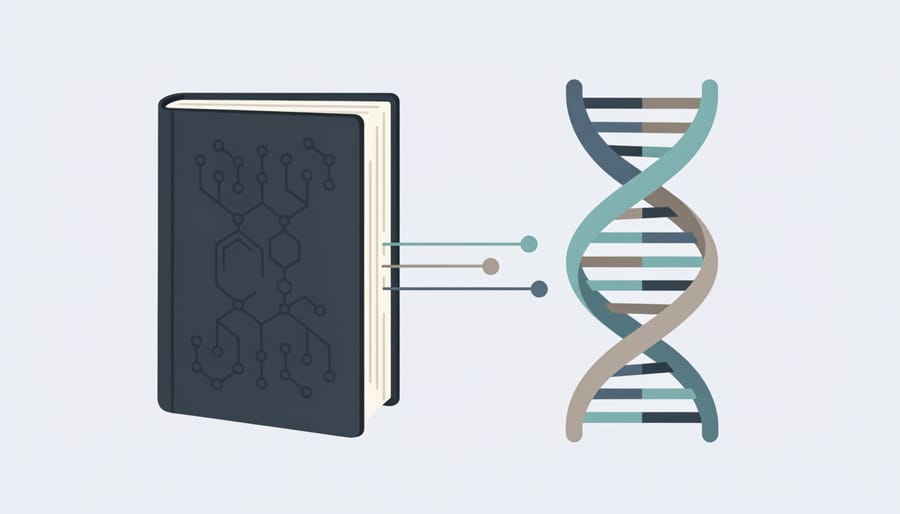
Imagine your child’s DNA as a very long book. It’s written in just four letters, A, C, G, and T, and it runs to about three billion letters. No one reads it cover to cover. A genomic language model is an AI tool built to do exactly that kind of reading.
Think of how a language model learns English. It isn’t handed a rulebook. It takes in huge amounts of text and picks up which words tend to follow which, and what a normal sentence looks like. A genomic language model does the same thing with DNA. It studies enormous amounts of genetic “text” and learns the grammar of the four-letter alphabet, so it can notice when something looks unusual.
Here’s a short glossary to keep the terms straight:
- Genome
- The complete set of genetic instructions a person carries, found in nearly every cell.
- DNA sequence
- The specific order of the letters A, C, G, and T along a stretch of DNA.
- Genomic language model
- An AI system that learns patterns in DNA sequences the way a text model learns patterns in sentences.
- Genetic variant
- A spot where a person’s DNA differs from the common pattern, like a spelling change in the book.
- Polygenic score
- A number that adds up the small effects of many variants to estimate a tendency, not a certainty.
- Language delay vs. language disorder
- A delay means a child is talking later than expected but may catch up. A disorder means difficulties that persist and need ongoing support.
This is different from the genetic testing many families have heard about. Traditional tests usually look for known changes in specific genes, like checking one named page for a known typo. A genomic language model looks at the wider patterns across the whole text, including parts we don’t yet understand well.
Why does any of this matter for early language? Because talking doesn’t come from a single gene. Many genes each add a small nudge, and a child’s world adds just as much: conversations, songs, books, play, and responsive adults. A model that can spot subtle patterns across many genes may help researchers understand part of that picture. It can’t tell us the whole story of any one child.
How These Models Learn to ‘Read’ DNA
Think of training a genomic language model as teaching someone to read in a language they have never seen. Here is how it works, step by step.
First, the model is shown a huge amount of DNA sequence, far more than any person could read in a lifetime. Second, it looks for patterns in that “text.” Just as a reader learns that certain letters and words tend to appear together, the model learns which DNA patterns commonly show up side by side. Third, once it has absorbed those patterns, it can do something useful: it can flag a stretch of DNA that looks unusual, or make an educated guess about how a section of DNA might behave.
So where do children’s early language milestones come in? In research settings, scientists sometimes run large studies that pair genomic data with language assessments, such as when a child says first words or how many words they use at age two. Models can then be used to search for links between the two. It’s careful detective work, not a finished answer.
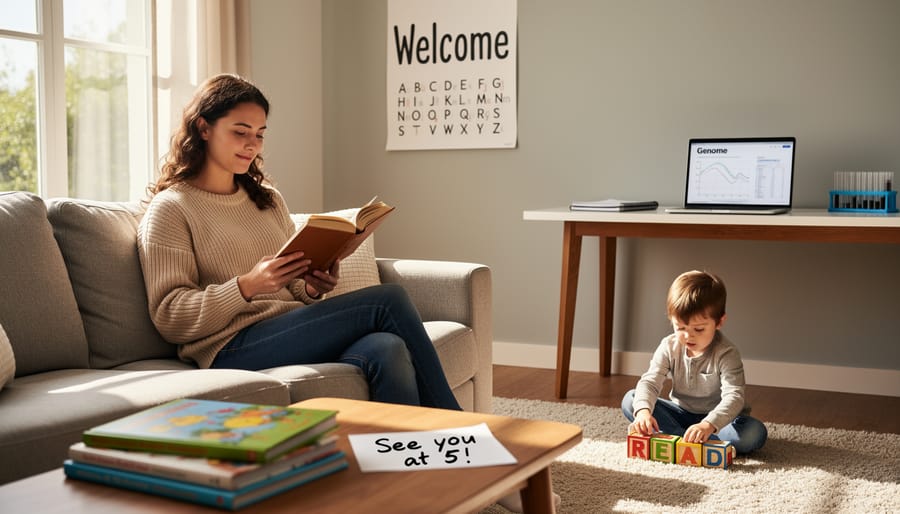
It also helps to know that language development rarely comes down to one gene. Many genes are involved, and each one tends to have only a small effect. On top of that, a child’s experiences matter enormously: talking, reading, singing, and play at home and at school all shape how language grows. Even family routines and parenting styles can influence how a child learns to communicate.
This is why researchers work in teams. Geneticists, speech-language pathologists, pediatricians, and educators each bring a different view of the same child, and together they can make better sense of what the patterns might mean.
Types of Genomic Models and the Information They Draw On
Researchers draw on a few different kinds of genomic tools, and each one answers a slightly different question. Many conditions that affect how children talk, learn, and connect have genetic components which is why scientists try several approaches rather than relying on one.
- DNA-sequence-only models: These learn patterns from the genetic “alphabet” alone and can flag unusual stretches of DNA, but they cannot tell us how a particular child will speak.
- Models that combine DNA with other biological information: These add details such as which genes are switched on in the brain, which can suggest how a change might matter, though they still describe biology rather than behavior.
- Polygenic scores: These add up many tiny genetic effects into one number, which helps researchers study groups of children but says very little about any single child.
- Behavioral and clinical information: Language assessments, hearing checks, developmental history, and health records show what is actually happening for a child, but they do not explain the biology underneath.
Put plainly, the genomic tools help researchers ask “why might this be happening?”, while the behavioral and clinical information shows “what is happening right now?” Neither is complete on its own.
That is why this work depends on teamwork. Geneticists interpret the DNA findings. Speech-language pathologists measure how a child understands and uses words. Pediatricians look at overall health and development, psychologists consider thinking, attention, and emotions, and educators share what they see in the classroom every day.
When these perspectives are combined, researchers can start to notice which genetic patterns line up with particular language profiles. Over time, this may help shape customized support that fits each child’s strengths and needs, rather than a one-size-fits-all plan. For families, the key point is that these tools are for understanding, not for labeling.
How Genomic Language Models Could Be Used in Early Language Research and Care
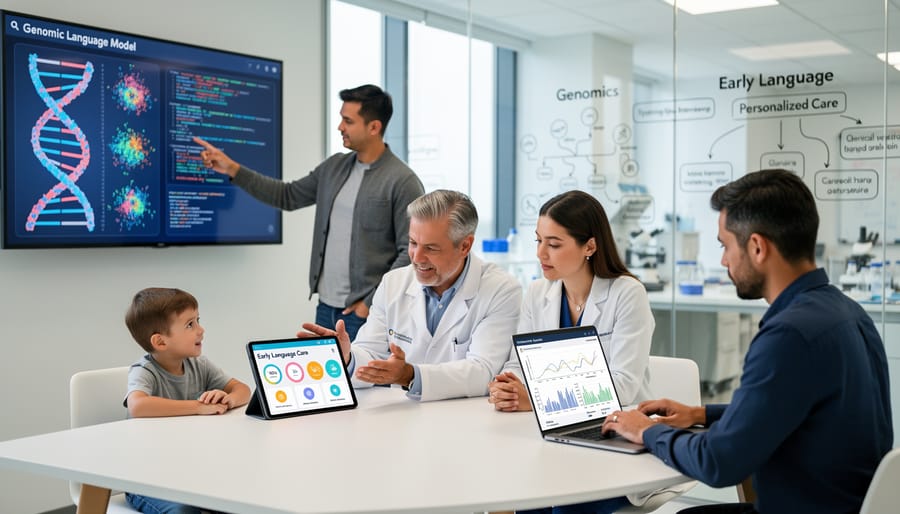
Genomic language models are not clinical tools yet, but researchers see several promising uses for them.
One is mapping the biology behind language difficulties. By scanning DNA from thousands of children, these models may help scientists spot which genes and regulatory regions are involved in early speech and language. That could point to the underlying biological pathways, such as how brain cells communicate or how circuits for sound and speech develop. Work in 7 traits genomics shows how studying several related traits together can reveal shared biology that single-condition studies miss.
Another is untangling overlap between conditions. Language delay often appears alongside autism, intellectual disability, or ADHD, and families understandably wonder why. Genomic models may help researchers see which genetic influences are shared and which are specific to one condition. Better answers could clarify how different neurodevelopmental pathways connect, and why two children with similar late talking can follow quite different paths.
The longer-term hope is more customized support. If genomic information, gathered in ongoing research, can be combined with what clinicians already learn about a child, it may eventually help refine therapy and support choices. For example, it might help explain why one child responds quickly to a particular approach while another needs something different. This is where a multidisciplinary approach matters most: geneticists, speech-language pathologists, pediatricians, psychologists, and educators each hold a piece of the picture.
It’s worth being clear about where things stand today. These are research directions, not routine care. Right now, understanding a child’s language development still relies on developmental observation, hearing checks, and a speech-language evaluation. A hearing test, for instance, can rule out a very common and treatable reason for slow speech. Genomic findings, if they ever become part of care, would add to these steps and never replace them.
Opportunities: What Makes This Approach Promising
The most exciting thing about genomic language models is their ability to notice what people simply can’t. A child’s genome contains billions of letters, and studies of language development can involve thousands of children. No researcher could read all of that by eye. These models can scan it at scale and flag faint patterns that might otherwise stay hidden.
That could matter in a few practical ways. Researchers may eventually learn which biological pathways are linked to speech and language difficulties, which gives them better targets for study. In time, that understanding might help clinicians recognize which children would benefit from support sooner, rather than waiting to see whether a delay resolves on its own.
There’s also a question every speech-language pathologist knows well: why do two children with very similar difficulties respond so differently to the same therapy? One makes quick gains while another needs a different approach. Genomic information, studied alongside behavioral and clinical findings, may help explain those differences.
Over the long term, this points toward more personalized care. Picture a speech-language pathologist, pediatrician, psychologist, and geneticist sharing one picture of a child’s strengths and needs, then shaping a support plan around it.
None of this is ready for the clinic today. But the promise is real: better understanding now, and the possibility of better-matched support for children later.
Challenges and Cautions Families and Professionals Should Know
It is natural to feel hopeful about new technology and uneasy at the same time. Both reactions make sense, and a few honest cautions can help families and professionals keep the research in perspective.
Predictions are still limited. Language outcomes vary enormously from child to child. Even the best genomic tools can explain only a small part of why one child talks earlier than another. A model might point to a slightly higher or lower likelihood of a language difficulty, but it cannot tell you what will happen for your child.
Many late talkers catch up. A good number of toddlers who start talking late find their footing without lasting difficulty. A genetic pattern linked to language delay does not mean a child will have one, and treating it that way could cause worry that was never needed.
The data does not represent everyone. Most genomic research has drawn on people from a narrow range of ancestries and backgrounds. Tools built this way may work less well for children outside those groups, which raises real fairness concerns. Families in underrepresented communities deserve research that reflects them.
Privacy and consent matter. A child’s genetic information is deeply personal and lasts a lifetime. Children cannot consent for themselves, so parents and researchers carry a serious responsibility to decide who can see this data, how it is stored, and how it may be used later.
Results need to be explainable. A number or score means little without someone who can interpret it. Findings should always be explained in clear terms by a trained clinician, ideally within a team that includes geneticists, speech-language pathologists, pediatricians, and educators.
Environment and relationships still matter most. Talking, reading, singing, and playing with a child shape language in ways no genetic result can replace. Early intervention can make a meaningful difference regardless of anyone’s DNA.
Above all, a genetic result should never stand in for a developmental assessment. Hearing checks, careful observation, and a speech-language evaluation remain the foundation for understanding how a child is doing and what support will help.
Common Questions About Genomics and Early Language
Parents often have the same handful of questions when they first hear about genomics and speech. Here are short, plain answers.
Can a DNA test tell me if my child will have a language delay?
No. Language development depends on many genes with small effects, along with a child’s experiences, so a genetic result cannot reliably predict who will have a delay.
Is genomic testing available for late talkers right now?
Genomic approaches to language are mostly used in research settings. Some children with broader developmental concerns may be offered genetic testing by a specialist, but it is not a routine step for late talkers.
Does a genetic link mean nothing can be done?
Not at all. Genes are only part of the picture, and speech-language therapy, rich conversation, reading, and play all make a real difference.
What should I do if I’m worried about my child’s speech?
Talk with your pediatrician and ask about a hearing check and a speech-language evaluation. Seeking advice early is always reasonable, even if your child ends up catching up on their own.
Families sometimes also ask how their child’s genetic information is handled. Rules vary by region and by study, so it is worth asking any research team how data are stored, who can see them, and what consent covers. Reputable studies explain this clearly before you decide to take part.
If you would like to understand how published findings reach clinics and homes, our guide to reading a research journal offers a helpful starting point. Remember that new research takes time to become practical care, and your child’s own team, including pediatricians, speech-language pathologists, and teachers, remains the best guide for personalized support.
Genomic language models are a promising research tool. Someday, they may help us understand why language develops differently from child to child. Right now, though, they cannot predict or diagnose language delay, and they are not a substitute for a careful look at how a child is actually communicating.
What makes real progress for children is teamwork. Geneticists, speech-language pathologists, pediatricians, psychologists, and educators each hold a piece of the picture. When they share what they see, support can be shaped around one child’s strengths, needs, and pace rather than a one-size-fits-all plan.
If you’re worried about a little one’s speech, here is where to start:
– Notice and jot down what your child says, understands, and does to communicate.
– Ask your pediatrician for a hearing check and a speech-language evaluation sooner rather than later.
– Keep talking, reading, singing, and playing together every day.
– Share what you’ve observed with teachers and therapists so everyone works from the same page.
Early attention makes a real difference, and so does everyday connection. You don’t need to wait for science to catch up before you help your child find their words.