

Parenting style refers to the overall pattern of attitudes, behaviors, and emotional climate a parent creates when interacting with their child. These patterns shape how children learn, communicate, and engage with the world around them, particularly during the critical early years when language and social skills are rapidly developing.
The way you respond to your child’s babbling, the questions you ask at dinner, whether you explain your decisions or simply enforce them – these daily interactions form a framework that either accelerates or constrains language growth. Children raised in homes with rich verbal exchanges, responsive feedback, and emotional warmth typically develop stronger vocabulary, more complex sentence structures, and better social communication skills. Conversely, limited conversation, inconsistent responses, or harsh communication patterns can delay language milestones and affect a child’s confidence in expressing themselves.
Understanding parenting styles becomes especially important if your child has developmental differences or language delays. What works for one child may not suit another, and recognizing your natural approach allows you to make intentional adjustments that support your child’s specific needs.
This article breaks down the four main parenting styles identified by developmental researchers and examines exactly how each affects language acquisition. You’ll learn which specific behaviors within each style promote or hinder communication growth, backed by current research in speech-language development and neuroscience. Most importantly, you’ll discover practical strategies to optimize your approach, whether your child is meeting milestones on schedule or needs additional support. The goal isn’t to label yourself or achieve parenting perfection – it’s to understand the tools you’re already using and refine them for your child’s benefit.
What Parenting Styles Mean for Your Child
Parenting styles are consistent patterns in how you interact with, respond to, and set expectations for your child. Researchers define these styles by looking at two key dimensions: how warm and responsive you are (your emotional connection and attention to your child’s needs), and how much structure and control you provide (your rules, expectations, and boundaries).
These patterns matter because your daily interactions create your child’s language environment, the total experience of words, conversations, and communication they’re exposed to. Every exchange shapes how your child learns to understand and use language. When you respond to your baby’s babbling, ask your toddler open-ended questions, or have back-and-forth conversations with your preschooler, you’re building the foundation for their communication skills.
- Parenting Style
- The characteristic pattern of behaviors, responses, and expectations you consistently use when raising your child, shaped by your warmth and your approach to control.
- Responsive Parenting
- Parenting that involves noticing and responding promptly and appropriately to your child’s signals, needs, and attempts to communicate, creating a foundation for secure attachment and language growth.
- Parent-Child Interaction
- The specific exchanges between you and your child, conversations, gestures, emotional responses, and shared activities, that form the context for learning and development.
- Language Environment
- The complete set of language experiences your child receives, including the words they hear, the quality of conversations, and opportunities to practice communication throughout their day.
The way you interact with your child creates thousands of micro-moments for language learning. A responsive approach, where you notice what catches your child’s attention, follow their lead, and build on their interests, gives them more opportunities to hear relevant words and practice using them. These conversational turns (the back-and-forth exchanges where you and your child take turns “speaking”) are particularly powerful for building language skills.
For children with neurodevelopmental differences or those at risk for language delays, these interaction patterns become even more significant. Your parenting approach can either amplify the language-learning opportunities your child receives or inadvertently limit them. Understanding this connection empowers you to make small, intentional adjustments that support your child’s communication development, regardless of where they’re starting from.
The Four Main Types of Parenting Styles
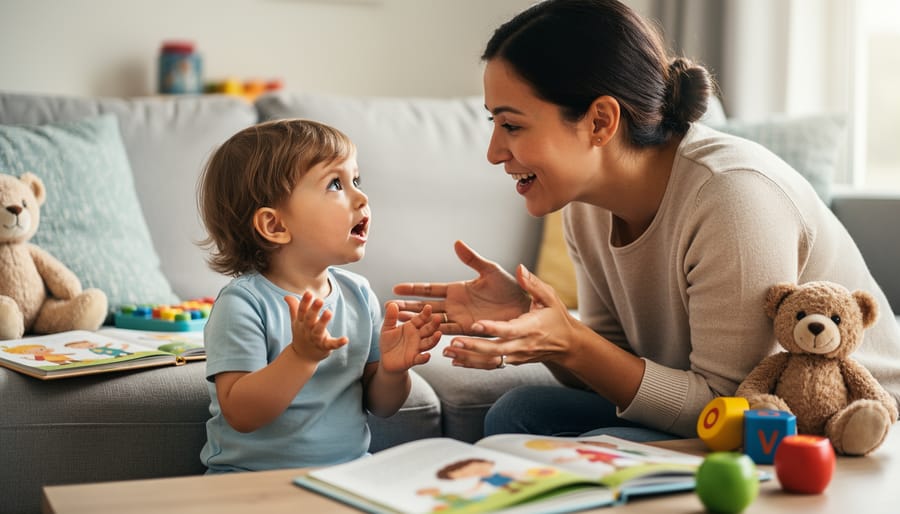
Authoritative Parenting and Language Growth
Authoritative parenting creates an ideal environment for language growth by combining warmth with structure. Parents who use this approach engage in frequent, responsive conversations with their children, treating even a baby’s coos or a toddler’s single words as meaningful communication worth responding to. This responsive serve-and-return pattern, where the child communicates and the parent responds, then waits for the child’s next turn, builds the neural connections that support language development.
These parents naturally expand their child’s language. When a two-year-old points and says “dog,” an authoritative parent might respond, “Yes, that’s a big brown dog! He’s wagging his tail.” This response validates the child’s communication, introduces new vocabulary (big, brown, wagging), and models more complex sentence structure, all while maintaining the conversation’s warmth.
The clear expectations part matters too. Authoritative parents explain things, give reasons, and invite questions, which means children hear rich, varied language throughout the day. A parent might say, “We need to leave in five minutes because your sister has soccer practice,” rather than just “Get your shoes.” These everyday explanations expose children to cause-and-effect language, time concepts, and reasoning skills.
Children raised with this style tend to develop larger vocabularies earlier and show stronger communication skills, partly because they practice language in a safe, encouraging environment where their words consistently receive thoughtful responses.
Authoritarian Parenting and Communication Patterns
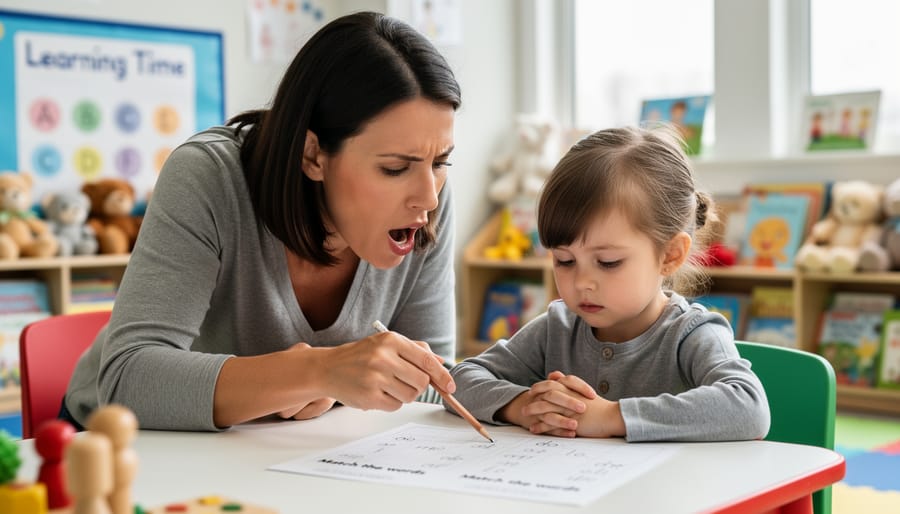
Authoritarian parenting centers on strict rules, obedience, and one-way communication from parent to child. This approach typically involves directives (“Do this now”), corrections (“Don’t say it that way”), and limited tolerance for questions or negotiation. While structure provides benefits, the communication pattern itself can restrict language learning opportunities.
Children raised with heavily authoritarian styles often experience fewer conversational turns. When interactions consist mainly of commands and corrections rather than open-ended conversations, kids get less practice expressing ideas, asking questions, or elaborating on thoughts. They may learn to listen and follow instructions well but have fewer chances to build expressive vocabulary or practice complex sentence structures.
The directive nature of communication can also affect how children view their own voice. If most interactions involve being told what to do rather than being asked what they think, some children become hesitant to initiate conversation or share ideas. They may wait to be called on rather than spontaneously communicating.
This doesn’t mean structure is harmful. Clear expectations matter. The issue arises when control overshadows conversation, leaving little room for the back-and-forth exchanges that build language skills. Even small adjustments, like asking “What do you think we should do?” before giving instructions, can create more language-rich interactions.
Permissive Parenting and Language Exposure

Permissive parents typically create warm, accepting environments where children feel comfortable expressing themselves freely. This emotional safety can encourage children to experiment with language, ask questions without fear of judgment, and develop confidence in their communication abilities. Children in these households often receive plenty of verbal interaction and emotional support during conversations.
However, the lack of consistent structure and boundaries can limit certain types of language exposure that support development. Without regular routines around reading, mealtimes, or bedtime conversations, children may miss predictable language-learning opportunities. Permissive parents might follow their child’s lead so completely that they don’t introduce new vocabulary or complex sentence structures the child wouldn’t encounter independently.
The reduced guidance can also mean fewer corrections of grammatical errors or pronunciation problems. While harsh corrections harm communication confidence, gentle modeling of correct language helps children refine their skills. Children with permissive parents sometimes struggle with understanding conversational rules like turn-taking, staying on topic, or adjusting their communication style for different situations.
For children with language delays or neurodevelopmental differences, the absence of structured language-building activities may slow progress. These children often benefit from deliberate vocabulary teaching and consistent communication patterns that permissive parenting doesn’t naturally provide.
Uninvolved Parenting and Developmental Risk

Uninvolved parenting represents the most concerning pattern for language development. Parents who are disengaged, whether due to stress, mental health challenges, or other circumstances, provide minimal responsiveness and limited structure. Children in these environments typically receive far fewer conversational turns and less varied vocabulary exposure than their peers.
The impact on language acquisition can be severe. Without regular back-and-forth communication, children miss critical opportunities to build neural pathways for speech and understanding. They hear fewer words daily, experience less modeling of conversation patterns, and lack the emotional connection that motivates communication attempts. Research shows that parental influence on language development is particularly crucial for children at risk for neurodevelopmental differences, making low engagement especially concerning for these vulnerable populations.
Children with existing language delays or autism spectrum characteristics face compounded risk when parental engagement is low. They often need more intensive, not less, interaction to develop communication skills. The combination of biological vulnerability and reduced environmental support can widen developmental gaps significantly.
If you recognize uninvolved patterns in your parenting, know that change is possible. Small increases in engagement make measurable differences, and professional support can help you build more responsive interaction habits.
How Parenting Styles Shape Language Development
The Role of Conversational Turns
Conversational turns, those back-and-forth exchanges where you speak, your child responds, and you reply again, are fundamental building blocks of language development. Each turn activates multiple brain regions responsible for processing sounds, understanding meaning, and forming responses. Research shows that children who experience more conversational turns develop stronger language skills, regardless of family income or background.
What makes these exchanges powerful isn’t just hearing words. It’s the contingent response, when your reply directly relates to what your child just said or did. This teaches children that their communication matters and that language is a tool for connection. A toddler points at a dog, you say “Yes, that’s a big brown dog,” and they attempt “dog”, that’s one turn building neural connections.
Responsive parenting naturally creates more turns because it prioritizes tuning in to what captures your child’s attention rather than directing the conversation elsewhere. Parents who follow their child’s lead, wait for responses, and build on their child’s interests create dozens more conversational exchanges each day. Over months and years, this accumulates into thousands of additional practice opportunities that strengthen the neural pathways supporting language comprehension and expression.
Quality and Quantity of Language Input
Children need both volume and value in the words they hear. Research shows that by age three, some children have heard 30 million more words than others, a gap that tracks with vocabulary size and later reading skills. But raw word count isn’t everything. A child overhearing adult conversations all day gets far less benefit than one engaged in responsive exchanges where caregivers talk directly to them, adjust complexity to their level, and pause for their responses.
Authoritative parents tend to provide both quantity and quality naturally. They narrate activities (“Let’s put the red blocks in the tall tower”), ask open-ended questions (“What do you think will happen?”), and expand on their child’s attempts (“Yes, doggie! That’s a big brown dog”). This child-directed speech, simpler grammar, clear pronunciation, exaggerated intonation, helps children map sounds to meanings.
Authoritarian households may offer fewer conversational turns despite adequate overall words, since directives (“Do this now”) don’t invite elaboration. Permissive parents often provide warmth and responsiveness but may miss opportunities to introduce new vocabulary or scaffold more complex language. The sweet spot combines frequent, emotionally warm interactions with intentional vocabulary stretching, describing, explaining, and building on what your child already knows.
Emotional Climate and Communication Confidence
The emotional atmosphere you create during conversations with your child directly influences how willing they are to speak up and try new words. Children who grow up in warm, supportive environments where mistakes are met with patience rather than criticism develop stronger communication confidence. They experiment more with language, ask questions freely, and persist when they struggle to express themselves.
When parents respond with interest and encouragement, even to incomplete sentences or mispronounced words, children learn that their attempts to communicate have value. This emotional safety net is especially critical during the toddler and preschool years when language skills are rapidly expanding. A child who feels secure will take the linguistic risks necessary for growth: using new vocabulary, attempting complex sentences, and initiating conversations with unfamiliar people.
Conversely, environments marked by frequent criticism, impatience, or dismissiveness can make children hesitant to speak. They may limit themselves to words they know they can pronounce perfectly or avoid talking altogether in certain situations. For children already facing language challenges, this emotional withdrawal compounds developmental difficulties. The confidence to communicate matters as much as the words themselves.
Applying Parenting Approaches to Support Language Growth
For Children with Typical Development
Children developing language on a typical trajectory benefit most from authoritative parenting’s blend of warmth and structure. The goal is creating daily opportunities for rich, meaningful conversation rather than formal teaching sessions.
Turn everyday routines into language-building moments. During meals, ask open-ended questions that require more than yes or no answers: “What made you laugh at school today?” rather than “Did you have fun?” When your child responds, expand on their ideas instead of moving to the next topic. If they say “Big truck,” you might reply, “Yes, that’s a huge delivery truck bringing packages to the store.”
Narrate activities as they happen, introducing new vocabulary naturally. Folding laundry becomes an opportunity to discuss textures, colors, and categories. Reading together offers chances to pause and predict what happens next, connecting story events to your child’s experiences.
The key is responsiveness. Follow your child’s interests and build language around what captures their attention, whether that’s dinosaurs, cooking, or building blocks. When you combine consistent engagement with genuine curiosity about their thoughts, you create the ideal environment for vocabulary growth and complex sentence development.
For Children with Language Delays or Disorders
When your child has a diagnosed language delay or disorder, your parenting approach becomes part of a coordinated treatment plan. Speech-language pathologists will teach you specific techniques to reinforce therapy goals at home, and adapting your communication style to support these strategies makes a significant difference.
Start by implementing the home practice activities your therapist provides, but extend their principles throughout daily routines. If therapy focuses on expanding two-word phrases, model this language level during mealtimes, bath time, and play rather than only during formal practice sessions. This consistent, naturalistic reinforcement accelerates progress.
Adjust your expectations and pacing to match your child’s current abilities. Slow your speech slightly, pause longer for responses, and reduce the complexity of your questions when your child struggles. These modifications reduce frustration while maintaining engagement.
Coordinate closely with all professionals involved in your child’s care. Occupational therapists, pediatricians, and educators may offer insights that inform your communication approach at home. Share what works in your family routines so therapists can build on your strengths.
Track your child’s progress and setbacks to identify patterns. Notice which times of day bring better communication, which types of prompts work best, and when your child seems overwhelmed. This information helps your therapy team customize treatment and adjust strategies as your child develops.
For Children with Autism or Other Neurodevelopmental Differences
Children with autism or other neurodevelopmental differences often thrive when parents combine authoritative warmth with specialized communication strategies tailored to their child’s unique processing style. Rather than expecting standard back-and-forth conversations, you might need to adjust your expectations and timing, allowing longer pauses for your child to process language and formulate responses. Visual supports, predictable routines, and clear language structures often work better than lengthy explanations.
The key is coordinating your parenting approach with your child’s therapy team. Speech therapists, occupational therapists, and behavioral specialists can teach you specific techniques that match your child’s sensory needs and communication preferences. You might learn to use augmentative communication tools, sign language, or picture exchange systems at home, creating consistency between therapy sessions and daily life.
Pay attention to what motivates your child to communicate. Some children respond best to highly structured interactions with clear beginnings and endings, while others need more flexibility. Watch for your child’s attempts to communicate through gestures, sounds, or behavior, and respond to these efforts the same way you would to words. This validation builds their confidence and desire to keep trying.
Your responsiveness matters more than perfection. Children with neurodevelopmental differences benefit tremendously when parents actively learn their unique communication style and adapt accordingly, creating a foundation for steady progress.
Common Questions About Parenting Styles and Language Development
Parents raising children with different developmental profiles often wonder whether their approach is helping or hindering language growth. These questions come up frequently in pediatric offices, therapy waiting rooms, and parent support groups.
Can I change my parenting style if I realize mine isn’t supporting language development?
Yes, parenting patterns are learned behaviors that can be adjusted with awareness and practice. Small shifts in how you respond to your child, like pausing to wait for their response or expanding on their words, can begin improving language interactions immediately.
What if I recognize myself in multiple parenting styles?
Most parents blend elements from different styles depending on the situation, their stress level, and their child’s needs. The goal isn’t perfect consistency but rather increasing the moments of warm, responsive communication that build language skills.
Will changing how I talk to my child really make a difference in their language development?
Research consistently shows that the quality and responsiveness of parent-child conversations directly shapes language growth, often more than socioeconomic factors alone. Even modest increases in back-and-forth exchanges and descriptive language create measurable benefits over time.
When should I be concerned about my child’s language development?
Trust your instincts if your child isn’t meeting milestones like babbling by 12 months, using single words by 18 months, or combining words by age two. Other red flags include limited eye contact during communication, difficulty understanding simple instructions, or regression in language skills they previously had.
How do I know if my child needs speech therapy?
If your child’s pediatrician expresses concern, if you struggle to understand your child when peers do, or if your child shows frustration trying to communicate, an evaluation by a speech-language pathologist can clarify whether intervention would help. Early assessment allows for earlier support if needed.
Many parents worry that recognizing problematic patterns in their own approach means they’ve caused lasting harm. That’s rarely the case. Children’s brains remain remarkably responsive to improved input, and language development continues well beyond the early years. What matters most is what you do moving forward.
Some parents feel overwhelmed by the idea of changing ingrained habits, especially when managing their own stress, work demands, or multiple children. Start with one small shift: maybe you commit to putting your phone down during meals to enable conversation, or you narrate your actions during daily routines to increase language exposure. These incremental changes compound over time.
For children already receiving services for neurodevelopmental differences, parents sometimes question whether their parenting approach even matters compared to professional intervention. The reality is that therapy works best when parents reinforce strategies at home through everyday interactions. Your communication style during the hours between therapy sessions often determines how well skills generalize to real life. A collaborative relationship with your child’s treatment team, where you’re learning and adapting alongside the professionals, creates the strongest foundation for progress.
Your parenting approach plays a real role in shaping how your child learns to communicate. The good news? You don’t need to be perfect. Small, intentional changes in how you interact with your child can create meaningful opportunities for language growth.
If you’ve recognized patterns in your interactions that might not be serving your child’s development, that awareness itself is a powerful first step. Moving toward more responsive, warm communication, even gradually, can open new pathways for learning. Ask questions, wait for responses, name objects and feelings, and create space for your child to practice using words in a supportive environment.
For parents of children with language delays, autism, or other neurodevelopmental differences, remember that you’re not alone in this work. The most effective support often comes from a team approach. Speech-language pathologists, occupational therapists, developmental pediatricians, and educators can work alongside you to create strategies tailored to your child’s unique needs and strengths.
Trust your instincts when something doesn’t feel right with your child’s communication development. Early intervention makes a significant difference, and seeking professional guidance isn’t an admission of failure, it’s an act of advocacy for your child.
Every child’s language journey looks different. Some talk early, some late. Some need extra support, some don’t. What matters most is that you’re engaged, responsive, and willing to adapt your approach as you learn what helps your child thrive. That commitment, more than any single parenting style, sets the foundation for communication success.